Training / Workshops

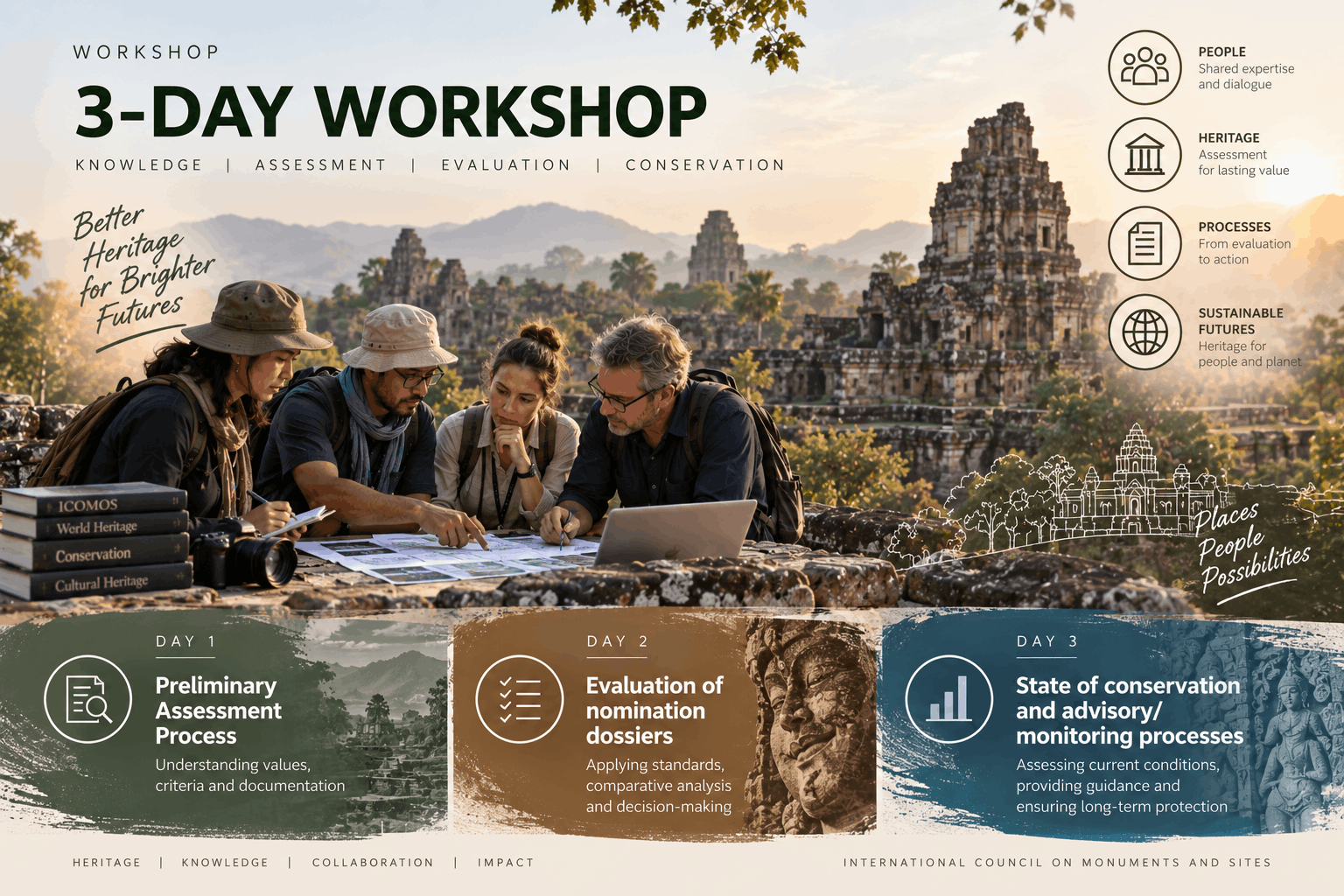
3-Day WorkshopDay 1: Preliminary Assessment Process
Day 2: Evaluation of nomination dossiers
Day 3: State of conservation and advisory/monitoring processes

Description

Context

Organised by ICOMOS World Heritage Evaluation Unit (Ms Gwenaëlle Bourdin) and World Heritage Advisory and Monitoring Unit (Ms Regina Durighello).
Date: 19, 20 & 21/22 October 2026 (2 hours per day)
Venue: Borneo Convention Centre Kuching (BCCK)
Limited to 100 participants only
Fees: Accessible by all ICOMOS GA2026 attendees. RSVP required

3 workshops organised over three separate evenings , each lasting approximately 2 hours. These sessions would address different and complementary aspects of World Heritage processes, in particular:

Day 1: Preliminary Assessment Process
Day 2: Evaluation of nomination dossiers
Day 3: State of conservation and advisory/monitoring processes

Each workshop would require a room with a capacity of approximately 100 participants and standard conference facilities (plenary seating, stage or speakers’ area, projection equipment, microphones, and appropriate technical support).

These workshops will be fully prepared, coordinated and delivered exclusively by the representatives of the ICOMOS World Heritage Evaluation Unit (Ms Gwenaëlle Bourdin) and World Heritage Advisory and Monitoring Unit (Ms Regina Durighello), together with the advisors/experts assigned to these units. It is essential for us to underline that these workshops are conceived as open sessions, accessible free of charge to all registered participants of the General Assembly, without restriction.

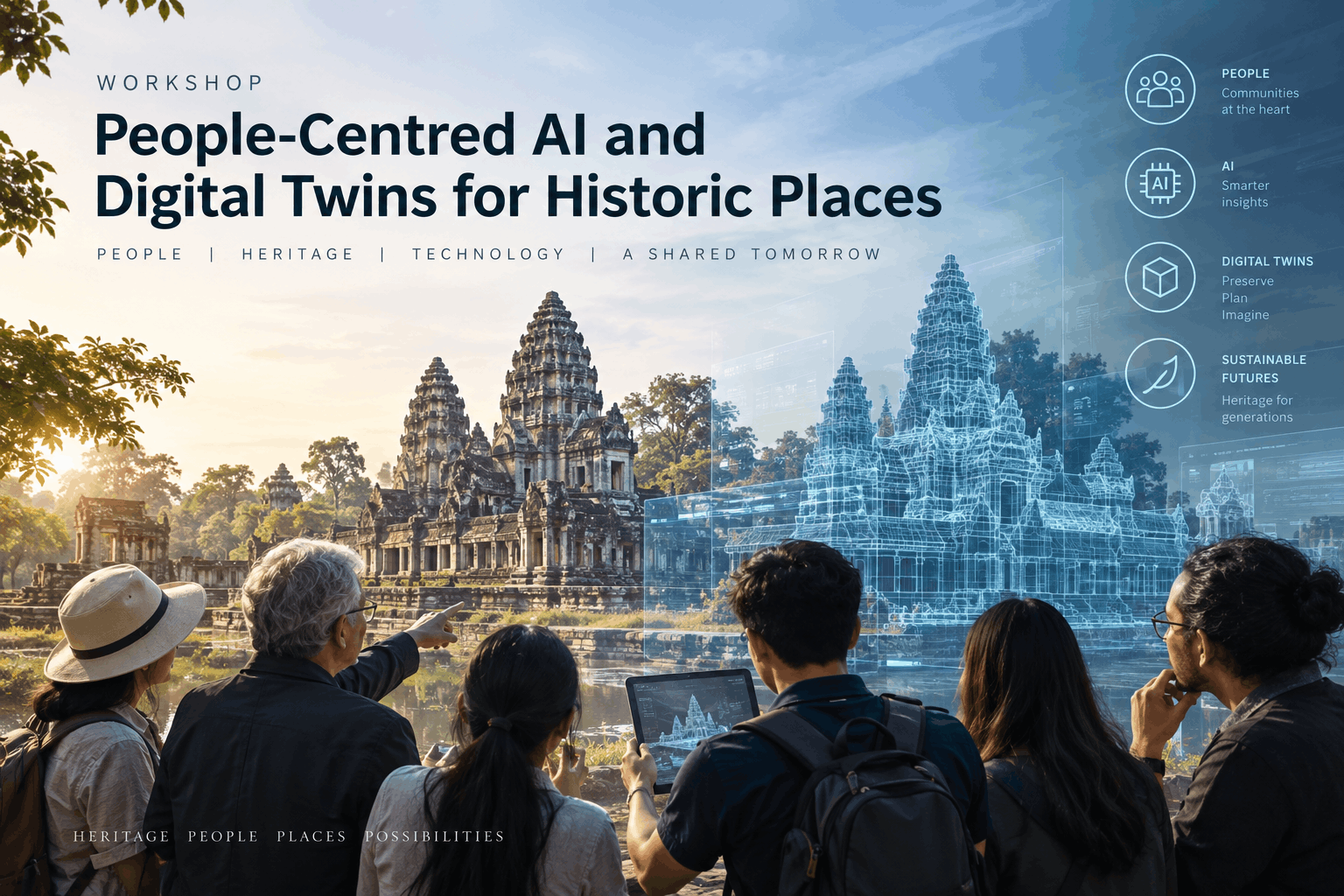
People-Centred AI and Digital Twins for Historic Places

Description

Context

Date: 15 October 2026 (1-Day Workshop)
Venue: Grand Margherita Hotel

Coordinator: Dr. Stacy Vallis (Auckland University of Technology); Dr Mario Santana (Carleton University)
Trainers: Eugene Ch'ng (Beijing Normal-Hong Kong Baptist University); Alex Yen (China University of Technology)

Fees: USD 100 / MYR 400
Limited to 40 participants only

Background

Carleton University and University of Azuay have established the UNESCO Chair on Digital Twins for World Heritage Conservation to advance research, education, and practice in heritage conservation in response to the growing challenges posed by climate change. Digital twins—dynamic, data-rich digital representations of heritage places that integrate documentation, monitoring, and analytical data—support predictive conservation, advanced visualization, informed decision-making, and collaborative heritage management.

The workshop is led by Stacy Vallis from Auckland University of Technology, a strategic partner of the UNESCO Chair, and Mario Santana Quintero, UNESCO co-chair; both Prof Vallis and Santana are presidents of their national committees. Organized in conjunction with the ICOMOS General Assembly 2026, the workshop aims to strengthen North–South collaboration, foster interdisciplinary knowledge exchange, and contribute to monitoring and achieving the United Nations (SDGs). The UNESCO Chair is supported by the ICOMOS/ISPRS International Scientific Committee CIPA Heritage Documentation.

Objectives

  • Promote inclusive, people-centred approaches to heritage conservation that integrate community knowledge, participation, and diverse values.
  • Introduce the application of artificial intelligence (AI), digital twins, and related digital technologies for the documentation, monitoring, management, and conservation of cultural heritage.
  • Demonstrate emerging and experimental methods for identifying, documenting, and monitoring the values and character-defining elements of historic places to support informed conservation and public interpretation.
  • Foster international collaboration and knowledge exchange among researchers, practitioners, and heritage institutions working at the intersection of digital heritage, conservation, and sustainable development.

UNESCO Masterclass - “TRAINING THE TRAINERS”(All-day event on 18 October)

Description

Click here to downlaod the poster

CALL FOR PARTICIPATION
UNESCO MASTERCLASS: TRAINING THE TRAINERS

CONSERVING OLD KUCHING: PRESERVING CULTURE, CONSERVING HERITAGE AND ENCOURAGING ARTS

Organised by ICOMOS CIF (cif.icomos.org)
Date: 18 October 2026 
Venue: Riverside Majestic Hotel (tentatively) & Old Kuching Town

Limited to 30 participants only
Profile of participant:  Teacher of architectural and urban conservation courses around the world, Conservation officials and officers from federal and local government and other relevant authorities. Limited places, pre-registration required by 20th July 2026

FEES:
Early bird until 31st July 2026:
Group of 5: RM 1000 (USD250)per person
Group of 2: RM 1100 (USD270)per person
Individual:   RM 1200 (USD295) per person
Fee on 1st Aug. 2026 & later:  RM 1200 (USD295) per person

DESCRIPTION:

ICOMOS-CIF will be delivering a UNESCO masterclass ‘TRAINING THE TRAINERS’ at Old Kuching Town. This is a very significant historic centre, with a remarkable diversity of cultures and architecture. Important developments are proposed in the area, integrating heritage preservation with smart technology and sustainable urban development. 

The masterclass is addressed to teachers, professionals in built environment, officers and officials from local authorities, state agencies and federal governments who are already working on built heritage, in order to advance their practices. After a series of keynotes and introduction to the local, national and international policies and principles, the participants will have the opportunity to work in small groups to produce an outline proposal for the area, which will be presented to local officials and the community.

Pre-register your seat by email the below information to enquiries@icomosga2026.org.my and cc. tanchinling18@gmail.com:
Title: UNESCO Masterclass: Training the Trainers pre-registration
a) Full name:
b) Affiliation/ Agency/ Organisation/ Institution:
c) Job title:
d) Qualifications/degrees/competences:
e) Email address:
f) Phone no.:
g) Address:  
h) Self-funded or organisation sponsored:
i) Dietary requirement:

Thank you.

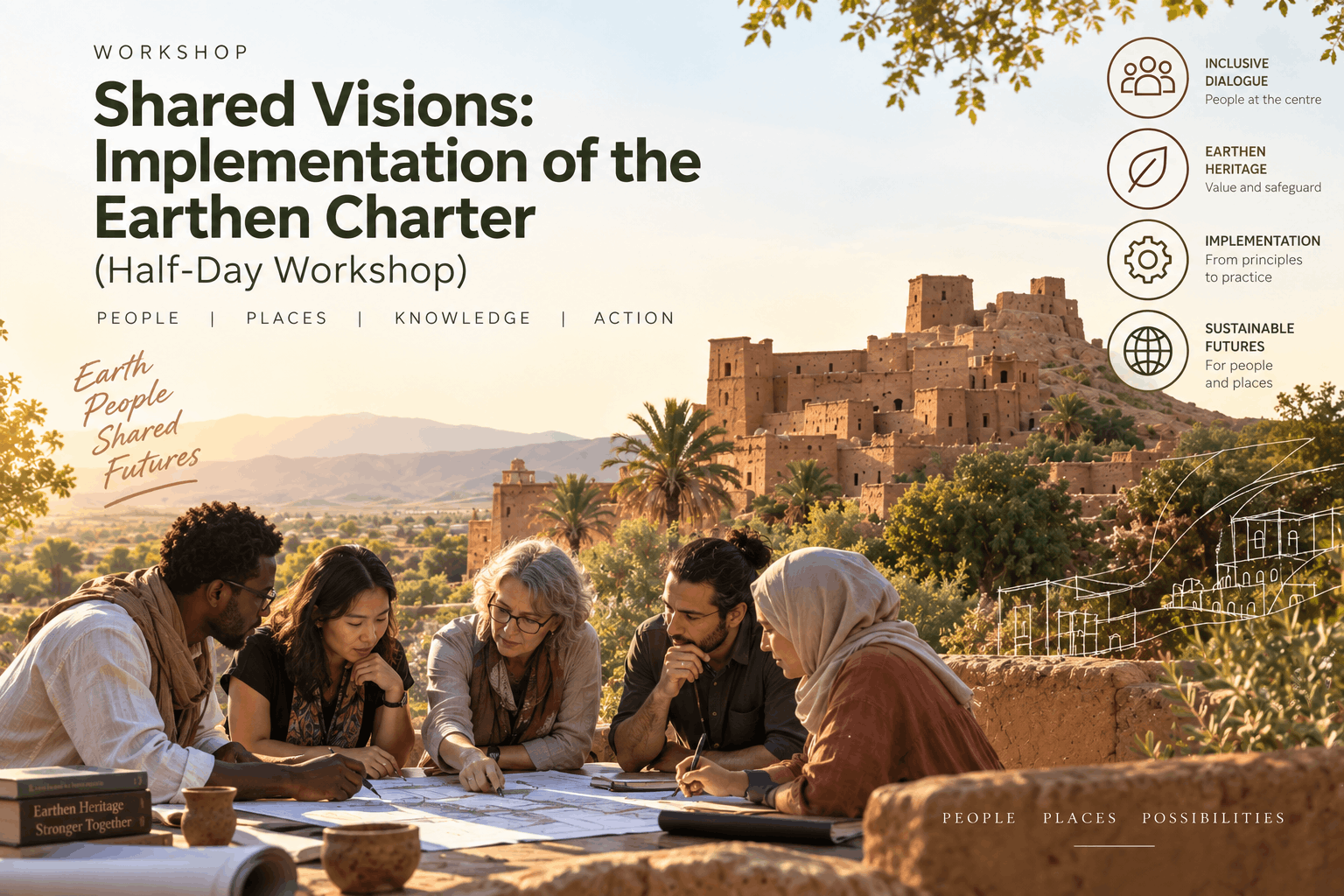
Shared Visions: Implementation of the Earthen Charter (Half-Day Workshop)

Description

Organised by ICOMOS ISCEAH
Coordinator: Dr. Mariana Correia (ISCEAH Charter Coordinator, Portugal), Dr. Amanda Rivera-Vidal (ISCEAH Vice-president, Chile), Dr. Jorge Tomasi (ISCEAH Chair of Landscape, Argentina)
Date: 22 October 2026
Venue: To be confirmed

Fees: To be confirmed

The aim of this Workshop is to create an open and plural space for designing a strategy that ensures the document has a real impact across the world.

  1. Presentation of ISCEAH Charter: Core concepts, and Charter’s development.
  2. Recently adopted Charter’s Roundtable: Representatives of Scientific Committees that have developed their own Charters in recent years, who will share the challenges that were faced, lessons learned and strategies addressed to apply their Charters.
  3. Open discussion forum: An open exchange space among representatives from different countries and regions to understand the plurality of conditions and contexts, on how to implement the Earthen Charter to contribute for conservation efforts in the protection and preservation of earthen architectural heritage in the different World regions. National and regional representatives will be encouraged to participate, seeking to ensure geographical diversity and diverse conditions when facing the preservation of earthen heritage.

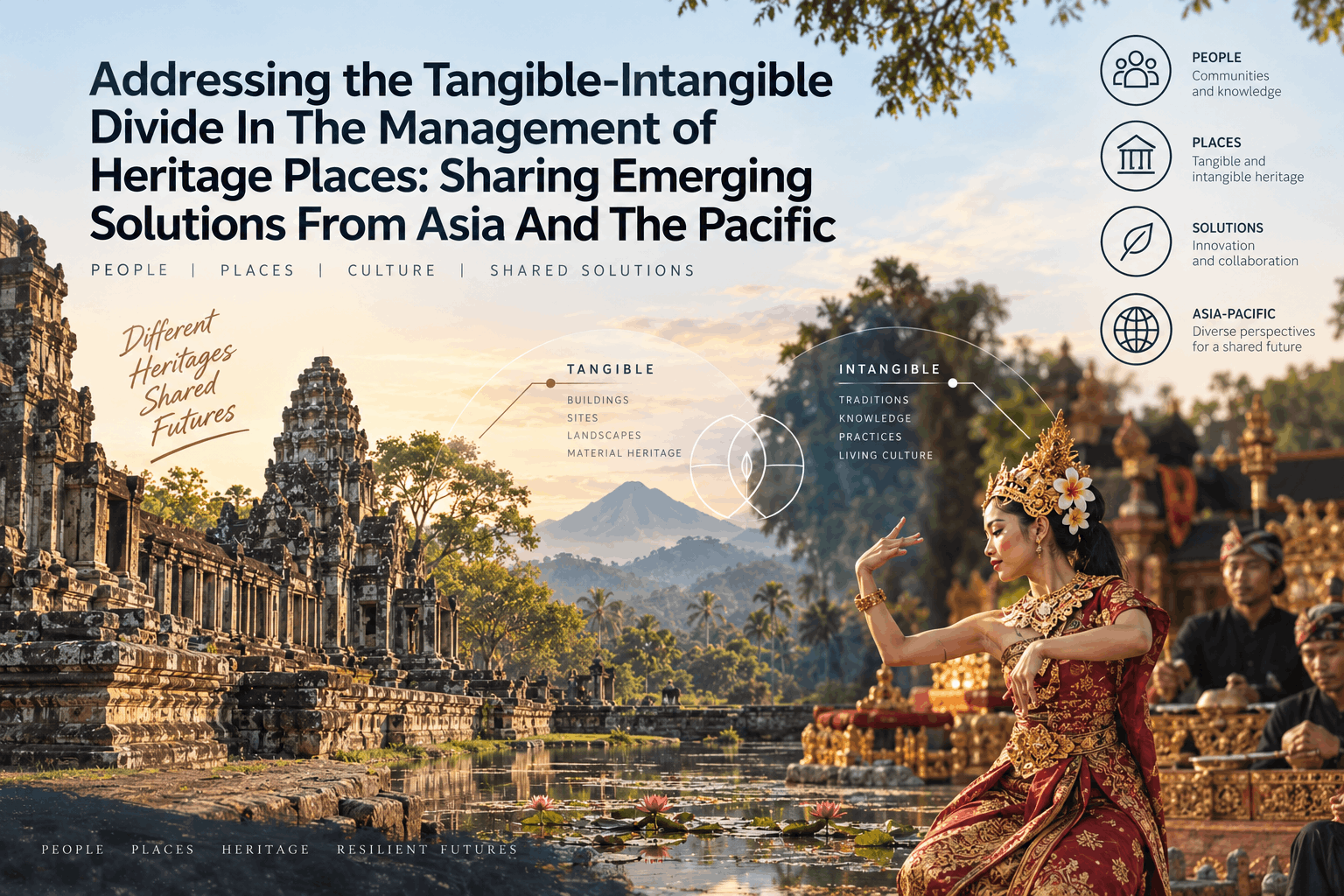
Addressing the Tangible-Intangible Divide In The Management of Heritage Places: Sharing Emerging Solutions From Asia And The Pacific

Description

Organiser: ICOMOS Australia, ICOMOS China, ICOMOS Nepal in association with UNESCO and WHITR-AP Beijing

Coordinator(s): Kristal Buckley (Australia ICOMOS), Haiming Yan (ICOMOS China), Neel Kamal Chapagain (ICOMOS Nepal), in association with Duong Bich Hanh (UNESCO) and Kuanghan Li (WHITR-AP Beijing)
Fees: Accessible by all ICOMOS GA2026 attendees (Limited to 100 participants only)

Date: 22 Oct 2026
Venue: To be confirmed

The aim of this Workshop is to share and consider further the outcomes of a recent Asia-Pacific Capacity-Building Workshop Tangible-Intangible Synergies in World Heritage Management. The focus of the workshop is a ‘management divide’ in the frameworks for the conservation of World Heritage sites and the safeguarding of intangible cultural heritage, despite the now-common recognition of the many overlaps between them throughout the world. Organized by WHITR-AP (Beijing), UNESCO’s Regional Office for East Asia, ICOMOS China, Peking University, and the Fujian Provincial Bureau of Cultural Heritage and held in Anxi and Quanzhou, China in August 2026, the workshop has a focus on the development of tools and strategies for more integrated practices.

  1. Presentation(s) will briefly outline the outcomes of the recent capacity-building workshop, particularly in relation to the needs of site managers
  2. A Facilitated Discussion Forum will collect responses, including additional strategies, drawn from the global membership of ICOMOS

Data to Dialogue: Mastering ICOMOS Tools for Heritage- Led SDG and VNRs Reporting

Description

Organisers: ICOMOS Sustainable Development Goals Working Group (SDGWG)
Co-ordinator: Dr Naima Benkari 

Rationale

As the 2030 Agenda enters its final implementation phase, Voluntary National Reviews (VNRs) and Voluntary Local Reviews (VLRs) have become one of the principal mechanisms through which governments demonstrate progress towards the Sustainable Development Goals (SDGs). Although cultural heritage contributes significantly to sustainable development, its role remains unevenly represented in national reporting.

In response, the ICOMOS Sustainable Development Goals Working Group (SDGWG), as part of the #Culture2030Goal campaign, has developed a suite of practical guidance and reporting tools to facilitate the systematic integration of cultural heritage into SDG reporting. These include the implementation of the #Culture2030Goal framework, particularly Target 3: "Protect and safeguard cultural and natural heritage and leverage it as a resource and enabler for sustainable development", together with its proposed indicators, as well as the Mapping Heritage Contributions to the SDGs template and the Structural Framework for a Cultural Heritage Subchapter in VNRs/VLRs. These resources have recently been introduced through a global programme of regional webinars for ICOMOS members and are now ready to be applied in practice.

This workshop represents the next step—from awareness raising to practical implementation—by enabling ICOMOS members to apply these tools using real heritage examples and to strengthen cooperation with national SDG coordination processes. Furthermore, this workshop addresses the critical "Policy Impact Narrative," establishing how integrating heritage into VNRs shifts the political perception of conservation from a cost centre to a core driver of sustainable development, thereby leveraging legislative and financial support in the post-2030 global framework.

Date: 22 Oct 2026
Venue: To be confirmed
Duration: 180 minutes

Objectives:

The workshop aims to:

  1. Strengthen the capacity of ICOMOS National and Scientific Committees to contribute to VNRs and VLRs
  2. Demonstrate practical methodologies for documenting heritage contributions to the SDGs
  3. Present the SDGWG reporting tools and experiment their practical application in the preparation of VNRs and VLRs
  4. Provide technical solutions for addressing data gaps and translating complex, qualitative cultural values into structured, quantitative metrics acceptable for national reporting
  5. Facilitate peer learning and exchange of experiences among National Committees; local and national government’s employees
  6. Encourage stronger engagement of heritage professionals with Ministries of Culture, national SDG coordination mechanisms and other relevant stakeholders
  7. Leverage the host country's upcoming 2027 VNR preparation as an active operational laboratory to test reporting tools against real-world institutional challenges.
Workshop Format
The workshop will combine structured briefings with interactive, data-driven breakout sessions:
 
Part 1: Strategic Orientation
• a strategic overview of the role of Voluntary National Reviews (VNRs), Voluntary Local Reviews (VLRs), and the emerging #Culture2030Goal agenda within the post-2030 Sustainable Development Framework;
• critical analysis of the systemic omissions regarding culture in the current SDG framework, and a presentation on the "Policy Impact Narrative" (how VNR inclusion triggers domestic funding and protection);
• presentation and live demonstration of the #Culture2030Goal framework, including Target 3 and its proposed indicators, together with the SDGWG reporting tools
 
Part 2: Technical Translation & Case Studies
• presentation of examples illustrating how these tools can be applied to support the integration of cultural heritage into national and local SDG reporting processes;
• a dedicated "Data Translation" segment detailing how to resolve data gaps and code narrative- heavy heritage practices into rigorous, quantitative indicators;
 
Part 3: Global VNR Sandbox: Practical Application & Localized Testing
• Participants will divide into localized breakout working groups to actively apply the SDGWG reporting tools:
• Using upcoming VNR/VLR cycles, including the host country’s 2027 framework, as live, real- world case studies, groups will work alongside committee members and policy experts to address explicit reporting challenges, stress-testing the tools against authentic political, data, and logistical constraints
 
Part 4: Synthesis & Plenary Discussion
• an interactive plenary discussion on national experiences, institutional challenges, opportunities for collaboration, and reporting back from the breakout tables on solutions devised for the 2027 reporting roadmap.
 
Expected Outputs
Participants will:
• Become familiar with SDGWG reporting methodologies and tools;
• Acquire practical skills for contributing to national SDG reporting;
• Establish connections between National Committees interested in SDG reporting;
• Contribute to strengthening ICOMOS engagement in the implementation of the #Culture2030Goal initiative and the future post-2030 global sustainability framework.
• Directly contribute to a draft strategic framework supporting the host country's 2027 VNR preparatory process.
 
Following the workshop, selected case studies and lessons learned, and the outcomes of the host country sandbox, will be compiled and disseminated through the SDGWG network and platforms as examples of good practice.